
Key Takeaways
- Industry estimates suggest around 20 per cent of homes sell off-market each year, so one in five opportunities never reaches the public.
- Off-market property is sold privately without advertising, which usually means less competition and calmer negotiation, not an automatic discount.
- On-market means maximum public exposure; pre-market means a short private window before a public launch; off-market means the sale stays private throughout.
- For buyers, the biggest gains are reduced competition and more time for due diligence. For sellers, the gains are privacy, cost savings, and speed.
- Access comes down to relationships, so a well-connected buyers agent is usually the most reliable way into the silent market.
Industry estimates suggest that around 20 per cent of homes are sold off-market each year. This means one in five opportunities never reaches the general public. For buyers, this hidden market offers a chance to secure a home without the intense pressure of a public auction. For sellers, it presents a quiet, efficient way to move on without the disruption of a traditional marketing campaign.
At Amassed, we understand that navigating this hidden property network can feel overwhelming for both buyers and sellers. This guide explains how the silent sales process works, the clear benefits, the potential risks, and the strategic steps required to access these exclusive property deals. Whether you are buying a home or building an investment portfolio, understanding how off-market real estate works widens your search well beyond what you can find online. Roughly one in five off market deals happens this way, entirely out of public view.
What is off-market real estate?
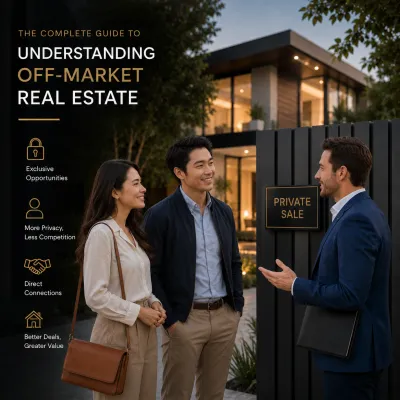
An off-market sale refers to a property transaction that occurs without any public advertising. When a home is sold as off-market property, you will not find it listed on major real estate portals. There will be no prominent signboard on the front lawn, no glossy brochures, and no scheduled public open homes for the neighbourhood to wander through.
Instead of a broad public campaign, the real estate agent discreetly approaches a select group of qualified buyers. These buyers are typically already known to the agent, either through an internal database or via professional relationships with buyers agents. The selling agent contacts them directly to arrange private inspections. In the industry, you might hear these properties called silent listings or pre-market opportunities. A true off-market property is one where the vendor has entirely ruled out public advertising, choosing to keep the process private from start to finish. While a traditional public campaign relies on maximum exposure to generate competition, an off-market strategy relies on targeted networking, matching a motivated seller with a serious buyer in a controlled environment.
What are on-market properties, and how do they differ?
On-market properties are the ones you are most familiar with. These are homes listed publicly on major portals like realestate.com.au and Domain, marketed with professional photography, floor plans, and often a signboard out front. The hallmark of an on-market campaign is maximum exposure, because the selling agent wants as many eyes on the property as possible to create competition, usually culminating in a public auction or a best-and-final-offers deadline.
The biggest advantage of buying on-market is transparency. Because the property is public, you can compare it easily to other listings, and the market value is validated by the crowd. The downside is pressure. When a property is advertised to everyone, you compete against everyone, and emotional buyers can push prices well above fair value. The choice between a public campaign and a private one often comes down to the same trade-off you weigh with auctions versus private treaty sales: exposure and social proof on one side, control and calm on the other.
On-market vs off-market: the key differences
To decide confidently, it helps to view the two approaches side by side. On visibility, on-market listings are available to anyone with an internet connection, while off-market listings are exclusive and generally require a relationship with the selling agent or a buyers agent even to know they exist. On competition and price, high on-market competition often drives the price upward through social proof, whereas lower off-market competition can lead to purchasing at fair market value, because the vendor often prioritises speed and privacy over squeezing out every last dollar. On speed, an on-market campaign usually follows a structured four-to-six-week timeline, while an off-market sale can happen very quickly or take longer, depending entirely on the motivation of the seller.
Off-market vs pre-market: what is the difference?
Many buyers use the terms off-market and pre-market interchangeably, but they are not the same thing, and the distinction changes how you approach competition and timing. A pre-market property is a home preparing to launch publicly that is being shown to selected buyers beforehand. The selling agent may already have photography booked and an auction date planned, but they are testing buyer interest early. This gives buyers a short window to inspect and potentially secure the property before it reaches the major websites, which is why a pre market property buyers advocate can be so valuable in that narrow window.
The key difference is intent. Off-market properties are usually intended to stay private throughout the sale. Pre-market properties are often still heading toward a public campaign if an acceptable offer is not secured early, which means pre-market buyers may still face future competition if negotiations stall. Off-market sales are quieter and more relationship-driven, while pre-market opportunities can move faster because the vendor is already preparing for broader exposure. Whether the property is off-market or pre-market, the fundamentals do not change: you still need to understand local values, assess long-term suitability, and negotiate based on research rather than emotion.
Are off-market properties actually cheaper?
Not necessarily. While many buyers assume off-market properties sell at a discount, the reality is more nuanced. An off-market sale simply means the property is being sold privately, and the final price still depends on location, demand, condition, and the motivation of the seller. In some cases, buying off-market creates better negotiating conditions because there is less public competition. In others, vendors expect a premium in exchange for the convenience and privacy of a quiet sale.
The biggest advantage of buying off-market is often reduced emotional competition. Without a public campaign attracting dozens of buyers, negotiations become more rational, which can create opportunities to purchase at fair market value rather than an inflated auction price. That said, off-market does not automatically mean bargain. In premium suburbs, some vendors deliberately choose private campaigns because they know certain buyers will pay for exclusivity, so a tightly held family home or waterfront residence may still attract competition behind closed doors. This is why understanding local market value, and knowing the cost of representation, remains critical before you chase off-market property deals or commit to any private sale.
What are the benefits of off-market sales for sellers?
Choosing to sell without public marketing might seem counterintuitive to anyone who believes maximum exposure brings the highest price. Yet many vendors find a silent listing aligns perfectly with their personal and financial goals.
Privacy, cost savings, and less stress
Privacy is often the primary reason a vendor chooses not to advertise. Selling a home is deeply personal, and not everyone wants neighbours, friends, or colleagues to know their business. High-profile individuals use this method to stay out of the media, while families navigating a divorce or a deceased estate often prefer to handle the sale quietly. Landlords also favour off-market sales, since it lets them sell an investment property without alarming current tenants. There are real cost savings too. Running a traditional campaign is expensive, and by 2026 the average marketing spend in Melbourne runs between $6,500 and $8,000, while Sydney campaigns range from $4,500 to $10,000. Selling quietly bypasses these upfront costs and removes the heavy burden of keeping a home in display condition for weekend inspections.
A faster turnaround
A public campaign takes time to prepare. Booking a photographer, writing advertisements, and waiting for the launch can add several weeks. When a property sells silently, the agent can start making calls the moment the agency agreement is signed, and if a qualified buyer is found quickly, the property can be sold in a matter of days. For vendors with a time-sensitive relocation or financial situation, that speed is often worth more than chasing the last few thousand dollars.
What are the benefits of off-market sales for buyers?
For property seekers, accessing the silent market changes the entire dynamic of the purchase, shifting the balance to a more even playing field.
Reduced competition and more due diligence time
When a quality property is listed on a major portal, it immediately attracts thousands of views, crowded open homes, and competitive auctions. When you inspect an off-market property, you might be the only person viewing it that day, which lowers the risk of a fierce bidding war and helps you make considered decisions rather than emotional ones. Off-market transactions also move at a pace that allows proper due diligence, giving you room to organise comprehensive building and pest inspections, review strata reports, and investigate council zoning or flood mapping. That extra time, backed by careful feasibility and due diligence, protects buyers from costly mistakes.
Lower stress and exclusive access
Buying property is notoriously stressful, and standing in a crowded living room or bidding at a public auction can be an exhausting emotional rollercoaster. Private sales remove the public spectacle, with negotiations happening quietly through skilled representation in a calmer, more respectful environment. Relying solely on public websites also means you only see a fraction of what is actually for sale. Gaining access to silent listings opens an entirely new pool of inventory, and in tightly held suburbs where public listings are rare, tapping into these hidden opportunities is often the only way to secure a home, as our client results consistently show.
What are the risks and key considerations?
The off-market approach is not without challenges, and both buyers and sellers should weigh these before committing. For vendors, the most significant risk is underselling, because restricting the number of people who see a property can mean accepting an offer lower than the open market would have produced. Sellers also rely heavily on the agent’s network, so a smaller buyer pool can leave a property sitting unsold if the agent lacks active buyers in that suburb.
For buyers, patience is essential, because you cannot simply log on and scroll through fifty homes; your options are limited to what agents happen to have in their quiet network at that moment. There is also the risk of unmotivated sellers who list off-market simply to test the waters, with unrealistic price expectations and no genuine urgency. The biggest risk overall is the lack of price transparency. On the open market, competing bidders help validate the price, but off-market you are flying solo, which makes professional valuation analysis, buyers agency support, and thorough contract review even more critical.
How do you find off-market properties?
Uncovering these hidden homes in the off market real estate space requires a proactive approach, and access is rarely about luck. In most cases it comes down to relationships, timing, and local market knowledge.
Build relationships and get finance ready
Real estate agents are the gatekeepers to silent listings, so to gain access you need to become a preferred contact on their database. Attend local open homes, introduce yourself, explain exactly what you are looking for, and follow up regularly to show you are an active, serious buyer. Equally important, have your finances completely ready, because an agent will only offer a silent listing to a buyer who can execute a smooth transaction. If a vendor wants a quick, quiet sale, they do not have time to wait for mortgage pre-approval, so ensure your finance is unconditionally sorted before requesting access.
Engage a professional buyers agent
The most effective way to access the hidden market is to hire a professional. Buyers agents spend their entire working week networking with selling agents, tracking property data, and uncovering opportunities the general public never sees. Selling agents prefer dealing with buyers advocates because they know the transaction will be handled professionally and the client is finance-ready. This is how buyers agents find off market stock others miss, and how a well-connected off market property buyers agent secures access before a listing is ever typed up. Partnering with a dedicated team like Amassed gives you a direct line to these silent listings, and you can contact our team to discuss your brief and get on the network.
Frequently Asked Questions
Do buyers agents have access to off-market properties not listed on major websites?
Yes. This is one of the core reasons buyers engage them. Buyers agents build long-term relationships with selling agents who often contact trusted advocates before a property is publicly launched, giving their finance-ready clients access to investment and owner-occupier opportunities that never appear on realestate.com.au or Domain. A Gold Coast buyers agent, for example, leans heavily on this network in tightly held coastal streets.
How do buyers find high-end off-market properties?
Professional advocates use a mix of deep industry networking and proactive outreach. They monitor public records, track local developments, and send targeted letters to specific streets to find owners who might be willing to sell. For premium and luxury homes, this discreet, relationship-driven approach is usually the only way to uncover stock that owners deliberately keep private.
Can a buyers agent access off-market properties in Noosa and other coastal areas?
Yes. Coastal markets such as Noosa and the wider Sunshine Coast often have a higher share of silent listings, because lifestyle and waterfront vendors value discretion. A well-connected Sunshine Coast buyers agent with established local relationships can surface these opportunities that rarely, if ever, reach public portals.
Are off-market properties always cheaper?
No. While you avoid the emotional bidding of an auction, some vendors want a premium price for the convenience of selling quietly. The main benefit is securing the right property on fair terms, not an automatic discount, so independent appraisal and comparable-sales analysis are essential to confirm the asking price aligns with true market value.
Can I find off-market properties myself?
It is possible but difficult. You would need to contact selling agents in your target suburb regularly, attend inspections consistently, and stay top of mind, which takes real time and persistence. Because off-market properties move quickly, agents generally prioritise organised, finance-ready buyers, which is why many purchasers use an advocate to shortcut the process.
Is it riskier to buy off-market?
The main risk is reduced price transparency, since there are no competing public bidders to validate value. This makes professional due diligence, building and pest inspections, valuation analysis, and contract review even more important. With the right research and representation, off-market buying can be just as safe as an on-market purchase, and often calmer.
Why do investors target off-market property?
For many experienced investors, an off market investment is not just about exclusivity, it is about gaining access to opportunities before broader competition pushes prices higher. While publicly listed homes attract every buyer searching online, off-market opportunities are negotiated in a quieter, more controlled environment, and our guide to exclusive off-market deals goes deeper on how investors source them. In fast-moving markets, public auctions can quickly inflate pricing beyond fair value, whereas off-market negotiations let buyers analyse comparable sales, review due diligence reports, and negotiate terms without the pressure of a crowded campaign.
Many investors also target off-market opportunities because some of the strongest properties never reach public advertising. Long-term owners in tightly held suburbs often prefer discreet sales, especially with premium homes, inherited properties, or investment portfolios. Price is not the only lever either; settlement timing, contract conditions, and finance clauses can all be negotiated more flexibly in a private process. Off-market activity also varies by region. Brisbane has seen growing interstate demand, Melbourne and Sydney have long-established off-market networks in premium suburbs, and coastal markets like the Sunshine Coast frequently see higher levels of private selling for lifestyle and waterfront homes. Understanding how each local market operates is how buyers uncover opportunities that standard online searches miss.
Resources
- CoreLogic: Australian housing market data and insights
- ASIC Moneysmart: buying property and doing your research
- Australian Taxation Office: investment property basics
- Real Estate Institute of Queensland: buying and industry standards
- Australian Bureau of Statistics: residential property prices
- Queensland Office of Fair Trading: property agents and marketing
- Investopedia: fair market value explained

Elijah Turkovic is the founder of Amassed, a licensed buyer’s agent in Queensland (licence QPBL 4617660) and a member of the REIQ. He has spent more than 10 years in property, development and real estate, and lives in Broadbeach Waters on the Gold Coast.
He leads the team’s searches, due diligence and negotiations on home and investment purchases across Brisbane, the Gold Coast and the Sunshine Coast. Amassed acts only for buyers and takes no commissions, referral fees or kickbacks from sellers, agents or the inspectors it recommends.