
Key Takeaways
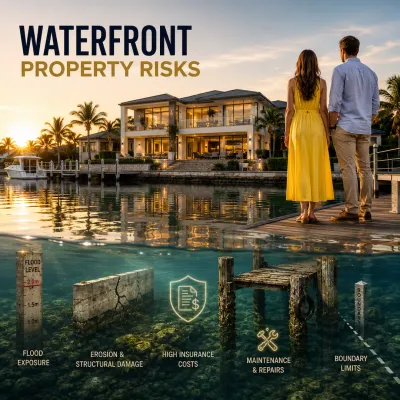
- Your boundary usually stops at the mean high-water mark; jetties and pontoons beyond it sit on Crown land and need a licence.
- Salt, humidity and erosion make waterfront upkeep far higher, so get a marine engineer, not just a standard building inspection.
- Flood risk drives insurance: high-risk waterfront premiums have jumped sharply, so always get an insurance quote before you buy.
- A water view can cost far more than an inland home; focus on land value and fundamentals, not just the scenery.
- Waterfront purchases are complex, so a specialist buyers agent checking boundaries, permits and structures protects your capital.
The dream of waking up to the sound of water lapping against the shore is a powerful motivator. Waterfront properties offer an unmatched lifestyle, combining stunning views with a sense of daily tranquillity. Whether it is a coastal retreat, a riverfront estate, or a home on a quiet canal, these locations hold a special place in the Australian imagination.
However, buying waterfront property is entirely different to purchasing a standard suburban home. The rules of engagement change as soon as water is involved. Behind the beautiful scenery lies a complex layer of legal boundaries, environmental exposures, and hidden costs that catch many unprepared buyers by surprise. A waterfront home is a significant financial commitment, and approaching the purchase without the right knowledge can turn a dream lifestyle into a costly burden.
Understanding the unique challenges of the coastal and riverine real estate market is essential. Buyers must navigate strict council regulations, interpret marine engineering reports, and factor in volatile insurance premiums. This is where Amassed provides critical support. By combining deep market knowledge with strategic negotiation skills, a specialist buyers agent helps you secure the right property while avoiding the hidden traps that cost ordinary buyers thousands of dollars
Common mistakes to avoid when buying waterfront property
The path to securing a premium waterside home requires careful due diligence. Here are seven of the most common mistakes buyers make and how you can avoid them.
Mistake 1: Not understanding ownership boundaries and rights
One of the biggest misconceptions about waterfront real estate is the assumption that your property boundary extends right down to the water. In Australia, this is rarely the case. The boundary for most waterfront homes is determined by the ‘mean high-water mark’. This is the average point that the highest tides reach over a specific period. Land below this mark is typically Crown land, which belongs to the state rather than the homeowner.
This distinction has massive implications for shoreline ownership and public access. If a property features structures like a jetty, pontoon, or boat ramp that extend past the mean high-water mark, those structures sit on public land. You do not own the land beneath them. Instead, you must hold a domestic waterfront licence.
In states like New South Wales, these licences are often issued for a period of 20 years. When purchasing a property, you must notify the relevant government department within 28 days of settlement to transfer the licence into your name. If the previous owner built unauthorised structures or has outstanding licence debts, those liabilities can transfer directly to you at settlement.
Mistake 2: Overlooking environmental exposure and maintenance
Living near the water means exposing your home to harsh environmental elements 24 hours a day. The impact of salt air, high humidity, and wind cannot be overstated. Salt spray accelerates the corrosion of metal fixtures, window frames, and even structural steel within concrete. Humidity creates the perfect breeding ground for mould, while constant wave action can lead to shoreline erosion.
These environmental factors result in significantly higher maintenance costs compared to inland properties. A waterfront home requires regular upkeep, including frequent painting, specialised cleaning of glass, and the use of expensive marine-grade materials for any repairs.
Standard building inspections are simply not enough for these types of properties. Buyers must arrange specialised inspections. You will need a marine engineer to assess the structural integrity of seawalls, retaining walls, and jetties. A seawall repair can easily cost tens of thousands of dollars, so knowing its exact condition before you sign a contract is absolutely vital.
Mistake 3: Ignoring local regulations and zoning laws
Waterfront locations are heavily regulated by local councils and state governments. Buyers who assume they can easily knock down an old home and rebuild a massive modern mansion often face severe disappointment. Zoning laws near water dictate everything from how close you can build to the shoreline to the types of materials you can use.
Flood zones are another critical factor. With shifting climate patterns, riverine and coastal flooding risks are increasing. This has a direct impact on insurance premiums. Recent data shows that home insurance premiums for high-risk, flood zones have jumped by up to 50 per cent. In some extreme cases, buyers in high-risk zones have received insurance quotes exceeding $70,000 a year. You must obtain an insurance quote before you finalise your purchase to ensure the ongoing costs are actually sustainable.
Furthermore, you need to investigate future development plans in the local area. A planned public marina or a new commercial development nearby could permanently alter the peaceful lifestyle you intended to buy.
Mistake 4: Misjudging privacy and lifestyle expectations
Waterfront living often projects an image of total seclusion. The reality is that the waterfront is a shared public asset. Because the area below the mean high-water mark is public land, members of the public have the right to walk along the foreshore, fish off the rocks near your boundary, or anchor their boats right in front of your house.
In popular coastal suburbs, this can lead to a significant lack of privacy during peak holiday seasons. Buyers must balance their desire for a pristine view with the practical reality of living in a highly desirable public location.
Additionally, accessibility can be a challenge. Many waterfront homes are built on steep blocks that require long staircases, inclines, or inclinator trams just to reach the front door. While this might seem manageable during an open home, bringing groceries down 50 steps in the rain will quickly test your patience. Evaluate the property based on everyday living, not just holiday mode.
Mistake 5: Failing to assess true value and investment potential
It is no secret that properties with water views command a premium. Some data suggests that living by the water can cost up to 86 per cent more than purchasing a comparable property just a few streets inland. However, paying a premium does not automatically guarantee superior capital growth.
Growth performance for waterfront properties fluctuates based on market cycles and environmental risks. When assessing value, smart investors focus heavily on the land value rather than the dwelling itself. A modest, older house sitting on a prime, level block of waterfront land is usually a much better long-term investment than a brand new luxury build on a compromised, steep block with limited water access.
Do not let the emotional pull of a beautiful view blind you to the financial fundamentals. Look at historical sales data for the specific street, understand the price ceiling for the suburb, and ensure you are not overpaying purely for the scenery.
Mistake 6: Neglecting utilities and infrastructure
When buying a waterfront property in a major city, you can generally expect standard connections to town water, sewerage, and electricity. But if you are looking at rural waterfront properties or homes in secluded coastal enclaves, utilities become a major logistical challenge.
Rural waterfront homes often rely on septic tanks instead of municipal sewage systems. These systems require strict maintenance and regular pumping. If a septic system fails near a waterway, it carries a massive risk of groundwater contamination, which can lead to severe health issues and heavy council fines.
Water supply is another consideration. Many off-grid or rural waterside homes rely entirely on rainwater. For a standard family home, this means installing water tanks that can hold between 30,000 and 100,000 litres to ensure a reliable supply during dry periods. Always check the capacity and condition of these utilities during your due diligence phase.
Mistake 7: Not consulting a specialist
Attempting to buy a complex waterfront property without expert representation is a major risk. The real estate agent selling the property works exclusively for the vendor. Their job is to secure the highest possible price and present the property in the best possible light. They are not there to highlight the flaws in the seawall or point out upcoming zoning changes.
A dedicated buyers agent levels the playing field. They conduct independent research, evaluate flood maps, interpret complex council permits, and handle the negotiation process. They know exactly what questions to ask regarding water rights, mooring limitations, and historical structural issues. Having a professional advocate in your corner is the best way to protect your capital and secure a property that truly meets your needs.
Do I Need a Buyers Agent for Waterfront Property?
Do I need a buyers agent for waterfront property? For most buyers, the honest answer is yes, and the reasons are specific to water. A standard purchase rewards local knowledge; a waterfront purchase punishes the lack of it. The checks that matter, mean high-water mark boundaries, marine structure licences, seawall condition, flood overlays and insurance viability, sit outside the expertise of most buyers and even most generalist agents. A single missed liability, such as an unlicensed jetty or a failing seawall, can cost many times more than a buyer’s agent fee.
A specialist buyer’s agent levels the playing field against a selling agent who works only for the vendor. They commission the right inspections, read the council permits, verify water access rights and negotiate on true value rather than emotional appeal. If you would like this handled end to end, book a consultation, and our client results show how that diligence protects buyers on complex coastal purchases.
Additional considerations for a successful purchase
Beyond the common mistakes, there are a few strategic factors that can influence your success in the waterfront market.
The best time to buy waterfront property is often during the winter months. In summer, demand spikes as buyers are drawn to the sun and the sparkling water. In winter, competition drops significantly. Viewing a property during a cold, windy, or rainy day also gives you a realistic understanding of how the home handles poor weather and poor light.
You should also look closely at the factors driving property values in the broader suburb. A great view is important, but proximity to high-quality amenities ensures long-term capital growth. Suburbs that are currently undergoing infrastructure upgrades or seeing an influx of new cafes, restaurants, and boutique shops often provide the best return on investment.
How Much Does Waterfront Property Insurance Cost?
Insurance is one of the largest and most volatile ongoing costs of owning waterfront property, and it can make or break the affordability of a purchase. Premiums reflect exposure to flooding, storm surge, coastal erosion and cyclone risk, so a canal or beachfront home can cost multiples of an equivalent inland property to insure. In designated high-risk flood zones, premiums have risen sharply in recent years, and in extreme cases quotes can reach tens of thousands of dollars a year, enough to change the entire investment case.
The rule is simple: never buy waterfront property without a written insurance quote in hand before your contract goes unconditional. Compare several insurers, ask specifically about flood and storm-surge cover, and factor the premium into your holding costs, not just the purchase price. Guidance from the Insurance Council of Australia helps you understand what drives the number, and on the Gold Coast canal market in particular, insurance can differ dramatically between neighbouring streets.
Waterfront vs Inland Property: Is the Premium Worth It?
Waterfront and near-water homes command a well-documented premium, with some analysis suggesting a water position can add substantially to the price of an otherwise comparable inland property. The real question is whether that premium translates into stronger long-term returns, and the answer is: sometimes. A premium paid for genuinely scarce, level, well-protected waterfront land tends to hold and grow; a premium paid purely for a view on a compromised block often does not.
The disciplined approach is to separate lifestyle value from investment value. If you are buying primarily for long-term investment, weight land quality, flood status, access and suburb fundamentals above the view itself. Reviewing historical sales data for the specific street, rather than the suburb average, is the clearest way to see whether the waterfront premium in that pocket has actually rewarded owners over time.
Amassed: Your partner in waterfront property acquisition
Navigating the complexities of coastal and riverfront real estate requires a highly specialised approach. Amassed acts as your dedicated partner in this process, providing the expertise needed to make a confident and secure purchase.
Our team understands that a waterfront home is both a lifestyle choice and a major financial asset. We conduct rigorous due diligence on every property, assessing everything from council zoning regulations and flood risks to the condition of existing marine structures. We leverage our extensive network to access off-market opportunities, giving you a competitive edge in highly sought-after locations.
We handle the difficult conversations and the tough negotiations, ensuring you pay a fair price based on true market value, not just emotional appeal. By identifying potential risks early and providing clear, unbiased advice, we protect your interests and help you secure a property that delivers lasting value.
FAQs about Buying Waterfront Property
What does the mean high-water mark mean for my property?
The mean high-water mark is the legal boundary line for most waterfront properties in Australia. It represents the average point reached by high tides. The land below this mark is generally Crown land. This means you do not own the actual beach or riverbed, and the public has the right to access the foreshore below this line.
Are insurance premiums always higher for waterfront homes?
Yes, insurance premiums are almost always higher. Waterfront homes face greater risks from severe weather, coastal erosion, storm surges, and flooding. Properties located in designated high-risk flood zones have seen massive premium increases recently. It is crucial to get an accurate insurance quote before signing any contracts.
Why do I need a licence for a jetty or pontoon?
Because jetties, boat ramps, and pontoons typically extend past your property boundary and sit on public Crown land, you must hold a domestic waterfront licence to use them. These licences require you to pay an annual fee and adhere to strict maintenance and environmental conditions.
Do I really need a buyers agent for a waterfront property?
Engaging an expert is highly recommended. The complexities of waterfront real estate are vast. A specialist from Amassed will evaluate marine structures, review complex council zoning laws, verify water access rights, and negotiate on your behalf, ensuring you do not buy a property with hidden legal or structural liabilities.
What should I consider when building on waterfront land?
Building on waterfront land requires careful planning and adherence to strict regulatory standards. You must consider tidal patterns, erosion risks, and flood zone classifications. Additionally, permits and engineering reports are essential to ensure the stability and environmental compliance of the structure.
How do waterfront properties affect insurance costs?
Insurance for waterfront properties is typically higher due to increased exposure to risks like flooding, storms, and water-related damage. It’s crucial to secure a comprehensive insurance policy tailored to the specific location and unique challenges of the property to safeguard your investment.
Is waterfront property a good investment?
Waterfront property can be an excellent investment, but only when the fundamentals stack up. Scarce, level, low-flood-risk land in a strong suburb tends to deliver solid long-term growth, while overpriced or high-risk blocks can underperform despite the view. Focus on land value, insurance viability and street-level sales history rather than scenery alone. For coastal markets, our property investment resources go deeper.
Making an informed waterfront purchase
Purchasing a property by the water is an exciting milestone, but it requires a pragmatic, analytical mindset. The view should be the final reward of a thorough due diligence process, not the sole reason for your purchase.
By understanding your legal boundaries, preparing for increased maintenance costs, and thoroughly researching local regulations, you can bypass the costly traps that ensnare emotional buyers. Approach the market with patience, engage the right experts, and focus on the fundamental value of the land. When you combine lifestyle aspirations with smart investment principles, a waterfront property can provide exceptional joy and strong financial security for decades to come.
Resources

Elijah Turkovic is the founder of Amassed, a licensed buyer’s agent in Queensland (licence QPBL 4617660) and a member of the REIQ. He has spent more than 10 years in property, development and real estate, and lives in Broadbeach Waters on the Gold Coast.
He leads the team’s searches, due diligence and negotiations on home and investment purchases across Brisbane, the Gold Coast and the Sunshine Coast. Amassed acts only for buyers and takes no commissions, referral fees or kickbacks from sellers, agents or the inspectors it recommends.