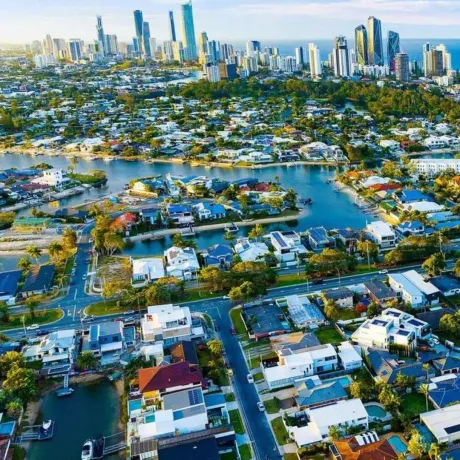
Most of the Gold Coast is low-lying, built on rivers, creeks, canals and old floodplains, so flood risk is part of buying here. The City of Gold Coast publishes detailed flood information online, if you know which map to use and what it leaves out.
This guide shows you how to check a specific property, what the maps and reports mean, how flood risk affects insurance, finance and resale, and when to walk away. It is general information, not legal, financial or insurance advice. Last checked against City of Gold Coast and Queensland rules: October 2026.
How do you check if a Gold Coast property is in a flood zone?
Search the address on the City of Gold Coast flood maps[1], then order a flood level search for the designated flood level. Do both before you make an offer if you can, and certainly before your contract goes unconditional.
- Search the address on the council maps (see the table below).
- Order a flood level search for the designated flood level.
- Compare it with the floor level of the house.
- Get an insurance quote for that address.
- Ask about flood history from the agent and neighbours.
Which City of Gold Coast flood map should you use?
The council’s flood maps page links to three separate online maps. They are built for different purposes, so a buyer usually needs at least two of them.
| Map | What it shows | Use it to answer | Limits |
|---|---|---|---|
| Flood risk awareness map[2] | The council’s newest city-wide flood modelling, in categories from maximum regional flood extent to very high risk | How exposed is this lot compared with the rest of the city? | River flooding only, not stormwater or storm surge. Part of a proposed City Plan flood update |
| Flood insurance map[3] | Whether the property could be affected in five flood scenarios, from a 20% to a 0.05% chance each year | How often could water reach it, and what will an insurer see? | River flooding only, not stormwater or storm surge. No depth and no climate change. For insurance purposes |
| Flood depth map[4] (titled “flood planning map”) | Approximate flood depth and the defined flood level for each property, in a 1% chance flood at the year 2100 planning horizon | How deep could the water get on this lot? | Regional flooding only, not stormwater. Order a flood level search for the formal level |
None of the maps shows local stormwater flooding, and the council says they shouldn’t be relied on alone to decide whether to buy. For site-specific flood advice it suggests a Registered Professional Engineer of Queensland (RPEQ), and for floor levels a licensed surveyor. The maps also shouldn’t be relied on during a flood event. For live warnings, use the council’s disaster and emergency dashboard[5] and the Bureau of Meteorology’s Queensland flood warnings[6].
How to read the map for one address
Read the lot, not the suburb, and look at the house itself, not just the edge of the block. Water across the back lawn is different from water through the living room. On the insurance map, note the most frequent scenario that touches the property: a home touched only in a 0.05% chance event is in a very different position to one touched in a 5% event. Check whether the street and access flood too, and screenshot what you find with the date, because council maps are updated.
Personal insights from Elijah
Elijah Turkovic · Founder & Licensed Buyer’s Agent
Seeing a flood overlay doesn’t automatically mean we walk away. The first thing is knowing how to use the council mapping properly and understanding exactly how flood-affected the property is.
We look at how much of the block is affected, how severe the flooding is, the expected flood depth or hazard, and the annual exceedance probability (AEP). Rather than simply saying “a one-in-100-year flood”, I want to understand the actual probability of that event occurring in any given year. Then we look at the type of flooding: river or creek flooding, local overland flow and stormwater, or another flood hazard.
From there we look at the house itself. What is the flood level compared with the finished floor level? Has the house been designed or elevated appropriately? Could access to and from the property be affected during a flood? And has it actually flooded in previous major events?
One of the biggest things most buyers miss is insurance. If we’re seriously considering a property with some level of flood risk, we look at preliminary insurance quotes before buying it. Premiums can vary dramatically from one property to another, even within the same suburb or street. If the premium is extremely high, or insurers won’t provide suitable flood cover, that can completely change the decision.
When a property looks unusually cheap for a good suburb, there’s normally a reason, and flooding is one of the first things we check. I’ve seen it in Brisbane, around Oxley, Darra and parts of Mount Ommaney: the price looked extremely attractive until you checked the flood mapping. Sometimes the discount isn’t an opportunity. It’s the market correctly pricing in the problem.
We have bought properties with lower levels of mapped flood risk where the property itself still stacked up. One was in Elanora. There was flood exposure, and the insurance premium was higher because of it. But the house had been built with its habitable floor level above the relevant flood level, so the house itself had much better protection from the mapped flood risk. That’s the distinction buyers need to understand.
If a friend asked me whether to buy in a flood zone, I’d tell them to stay away from heavily flood-affected properties. But a property with low flood risk can still be a good buy if the house is appropriately elevated, insurance is reasonable and the rest of the due diligence stacks up.
How do you get a Gold Coast flood report for a property?
Order a flood level search from the City of Gold Coast. The flood level search[7] report summarises the flood information for the property, including the estimated designated flood level and the ground level at the centre of the property. The fee for defined flood level information is $113 in the council’s 2026–27 search fees[8].
To order it, use the council’s online search request form and choose “Flood level information” under Plans, Maps and Documents. Council publishes an example flood report[9] so you can see the layout before you order.
Two limits matter:
- It covers riverine and regional flooding only. It doesn’t cover local flash flooding, when heavy rain overwhelms drains and overland flow paths.
- It doesn’t show the flood extent. It gives levels for the property, not a picture of how far water spreads.
Ask your conveyancer whether their searches include it. If not, order it yourself.
Does the seller have to disclose flooding in Queensland?
No. Under Queensland’s seller disclosure scheme[10], in force since 1 August 2025, sellers must give buyers a Form 2 disclosure statement before they sign. The Form 2 statement[11] says plainly that it doesn’t include information about flooding or other natural hazard history.
Instead, it tells buyers to make their own enquiries with the local council, and points to FloodCheck Queensland[12] and the Australian Flood Risk Information Portal[13]. FloodCheck says itself that it shouldn’t be used to judge flooding at the property level, so on the Gold Coast the council’s maps and flood level search remain the main tools.
If you don’t receive the disclosure statement before signing, or it is wrong on a material matter, you may have a right to end the contract before settlement, as the REIQ explains[14]. Because flooding isn’t in the statement, those rights won’t usually help you on flood. Do the checks before you sign, or make your contract conditional on them, and ask your solicitor how.
What is the designated flood level, and how high should the floor be?
The designated flood level (also called the defined flood level) is the height floodwater is expected to reach in the flood the council plans for. On the Gold Coast it is based on a flood with a 1% chance of happening in any year (1% AEP), coinciding with a storm tide for most areas. Levels are given in metres AHD, a height above a national reference point, not a depth.
Council’s example report explains that the level already allows for the State Government’s projected 0.8 metre sea level rise[15] by 2100, plus stronger storm tides and rainfall.
For new homes and major work, the council requires habitable floor levels to be at or above the designated flood level plus a minimum freeboard of 300 millimetres. Freeboard is a safety margin above the flood level. Queensland’s Building Regulation 2021[16] lets a council set the flood level and a freeboard above 300 millimetres.
What this means for a buyer:
- Floor above the flood level plus freeboard. The best position. Water may reach the yard in the planning flood, but the house is designed to stay dry.
- Floor above the flood level, less than 300 millimetres clear. Better than below it, but check the insurance quote carefully.
- Floor below the flood level. More likely in older homes built before current rules. Expect water inside in the planning flood, higher premiums and more questions at resale.
The flood level search gives you the level. The floor height has to come from a surveyor or the approved plans.
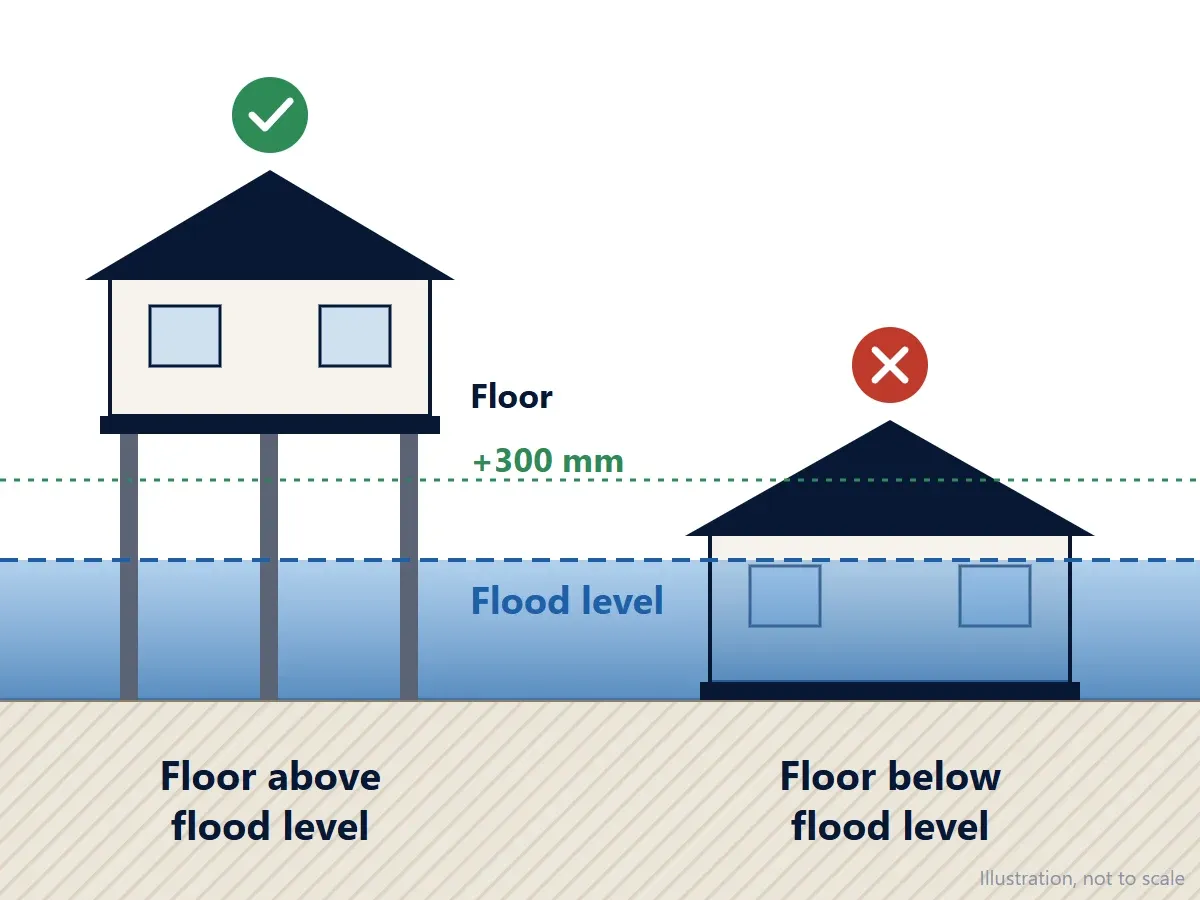
Same street, same designated flood level. The floor height decides whether water gets inside. The flood level comes from council’s flood level search; the floor level from a surveyor or the approved plans. Freeboard is the 300 mm safety margin new homes need above the flood level.
Which Gold Coast suburbs are in flood zones?
There’s no official list of “flood suburbs”, because flood exposure is mapped lot by lot. The council models flooding across six catchments in its flood modelling and risk assessment[17] work: Logan-Albert-Pimpama, Coomera, Loders-Biggera, Nerang, Tallebudgera-Currumbin and Coolangatta. The city also takes in Guragunbah, which the council describes in its planning for flood[18] page as Australia’s largest urban floodplain.
The Gold Coast faces three kinds of flooding:
| Type | What happens | Where to look harder |
|---|---|---|
| Riverine (regional) | Rivers and creeks rise after long, catchment-wide rain | Land near the Albert, Logan, Coomera and Nerang rivers and the Tallebudgera and Currumbin creeks |
| Storm tide | Wind, low pressure and high tide push seawater onto low land | Beachfront, canal and estuary land. Not on the awareness or insurance maps; the flood level search allows for it in most areas |
| Flash (local) | Short, intense rain overwhelms drains and overland flow paths | Low points anywhere, including suburbs far from a river. Not covered by the council maps or the flood level search |
Recent events show the pattern. In the February to March 2022 floods[19], the council recorded flash flooding to major levels along Tallebudgera and Currumbin creeks in Elanora, Tallebudgera and Currumbin Waters, and moderate to major riverine flooding in the Albert and Logan catchments, with inundation in Alberton and Stapylton.
Elanora shows why suburb labels mislead. It has flood-affected pockets, but Elijah’s view is that this doesn’t mean every Elanora property should be avoided: you assess the individual block and the house. Two homes in the same street can sit at quite different heights, so always check the address.
Which Gold Coast suburbs have the lowest flood risk?
Higher ground away from rivers, creeks, canals and the coastal storm tide zone carries the lowest flood risk: elevated land on the hills and hinterland edge, and the higher parts of inland suburbs. There’s no official “flood-free” list, though, and low-risk suburbs still have low points and overland flow paths, so treat “flood-free suburb” lists with caution. The council’s maps and a flood level search for the address are the only reliable test. Our guide to flood-free Brisbane suburbs applies the same approach to Brisbane.
Are canal and waterfront homes safe to buy?
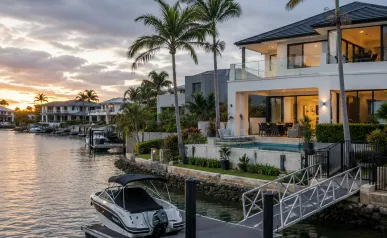
Many are, but canal and beachfront land is exposed to storm tide as well as rain, and waterfront homes often depend on a revetment or seawall that needs maintenance. Elijah’s view is that a canal address isn’t automatically a bad buy, but it should trigger further investigation into flood and storm tide exposure, the property’s levels and the height of the house. The council’s awareness and insurance maps don’t show storm surge, so for a canal home rely on the flood level search, which allows for storm tide in most areas, and compare it with the floor level. Check the condition of the wall too. Our Gold Coast canal and waterfront guide covers walls, pontoons and the questions to ask.
Beachfront land also faces erosion, which is a separate hazard from flooding and sits under a different City Plan overlay. A beachfront home can stay dry in a flood and still be exposed to erosion.
What did Cyclone Alfred teach Gold Coast buyers?
The council describes Tropical Cyclone Alfred[20] as one of the most significant weather events the city has faced in the past 50 years. From 6 March 2025 it brought destructive winds, extreme rainfall, flash flooding and destructive storm tides. The council’s beaches restoration project[21] estimates around 4 million cubic metres of sand were lost from the beaches.
Two lessons for buyers:
- Separate the hazards. Wind, erosion, storm tide and flooding affect different properties. Check each one for the address, not just “is it flood prone?”
- Look at how the street coped. Ask what happened in the property and the street in March 2025. Recent events tell you more than any brochure.
Does flood risk affect insurance?
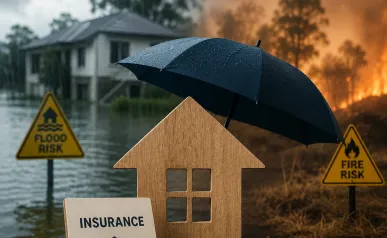
Yes. Since June 2012, home insurers have used a standard definition of flood, explained by the Insurance Council of Australia[22]. Flood cover is offered in four ways depending on the insurer: included as standard, included with an option to opt out, available to opt into, or not included. The Insurance Council also says property owners with a high flood risk pay a higher premium.
ASIC’s Moneysmart guide[23] puts it simply: if your home is at a high risk of flooding, insurance will cost more, or flood cover might be excluded. Before you buy:
- Get a quote for the actual address, with flood cover included, from more than one insurer.
- Read the Key Facts Sheet and policy for how flood, storm and storm surge are covered, and the excess.
- Ask the seller what they pay, then confirm with your own quote. Premiums can change at renewal.
The federal cyclone reinsurance pool[24] backs insurers for cyclone and related flood damage and is designed to reduce premiums, but your own policy terms still decide what’s paid.
Does flood risk affect your home loan and resale?
It can. Lenders usually require building insurance to be in place before settlement. ANZ[25], for example, says it needs to make sure your new property is protected with building insurance before settlement. So a home that is hard or expensive to insure can become a finance problem late in the purchase. Talk to your lender or broker early, and confirm insurance before your finance date. Our guide to how much deposit you need covers the finance side.
Resale works the same way: the next buyer sees the same maps and insurance quotes, so a home that is cheaper because of flood exposure may stay cheaper when you sell.
Should you buy in a Gold Coast flood zone?
Sometimes, yes. Most of the city is low-lying, so plenty of good homes have some flood mapping. The question isn’t whether the property is mapped, but whether the risk is understood, priced in and insurable. Use a simple traffic-light test:
| Signal | What you find | What to do |
|---|---|---|
| Go | Only touched in rare scenarios, floor well above the flood level plus freeboard, normal insurance quote | Proceed with normal due diligence |
| Caution | Yard or street affected in more frequent events, floor near the flood level, higher premium | Price in the extra insurance and any works, and negotiate |
| Walk away | Floor below the flood level, water inside in frequent scenarios, flood cover excluded or unaffordable, or the lender is unsure | Walk away unless the price and your plans genuinely account for it |
Can you negotiate on a flood-affected property?
Sometimes, but it’s usually not the big bargaining tool buyers expect. Elijah’s rule is that a discount isn’t a reason to buy a property with medium to high flood risk. With lower-risk properties, flood exposure can be part of the negotiation, particularly where insurance is higher or resale is likely to be affected.
There’s no standard discount. Weigh it against the flood exposure, the insurance quote, comparable sales and the future buyer pool, and bring evidence: the quote, the flood level and the floor height.
For the full buy-or-walk-away decision, including how to check past flood repairs, see should you buy a flood-affected property in Queensland. For bushfire, storm and other climate risks, see our guide to buying a climate-resilient home.
What should you check before going unconditional?
Use this checklist alongside your due diligence checklist:
- Before you offer: check the council maps and ask the agent about flood history.
- In the contract: give your finance and due diligence conditions enough time for the flood level search and insurance quotes. Ask your solicitor about the wording.
- Flood level search: compare the designated flood level with the floor height.
- Insurance: get written quotes with flood cover, and read the excess.
- Finance: tell your lender about the flood exposure and confirm their insurance requirements.
- Inspection: a building and pest inspection reports on condition, not flood risk, but can pick up past water damage and damp.
- Neighbours: ask what happened in March 2025 and earlier storms.
Frequently asked questions
What is the official Gold Coast flood map?
The City of Gold Coast’s three online flood maps: the flood risk awareness, flood insurance and flood depth maps. For a property’s formal designated flood level, order a flood level search.
How much does a Gold Coast flood report cost?
A council flood level search costs $113 for defined flood level information under the City of Gold Coast’s 2026–27 search fees. Order it through the council’s online search request form.
Does a flood overlay mean the property will flood?
No. An overlay shows the land could be affected in a modelled flood. Whether the house itself gets wet depends on its floor height, the flood scenario and local drainage. Check the flood level against the floor level.
Does the flood level search cover flash flooding?
No. The council’s flood maps and flood level search cover riverine and regional flooding only, not local flash flooding from intense rain. Look at drainage, low points and overland flow paths separately, and ask about past events.
Does the seller have to tell me if a house has flooded?
Not under Queensland’s seller disclosure statement. Form 2 says it doesn’t include flooding or natural hazard history and tells buyers to make their own enquiries. Ask the agent and neighbours directly, and check the council maps.
Can I get insurance for a home in a flood zone?
Usually, but it can cost more, and flood cover may be limited or excluded for high-risk homes. Get quotes with flood cover for the exact address before you go unconditional.
Will the bank lend on a property in a flood zone?
Often, yes, but lenders usually need building insurance in place before settlement. If a home is hard or expensive to insure, that can affect your loan. Speak to your lender or broker early.
Can I negotiate the price down if a property is in a flood zone?
Sometimes. With lower-risk properties, a higher insurance premium or a likely effect on resale can support a lower offer, but it’s rarely the big bargaining tool people expect. A discount alone isn’t a good reason to buy a property with medium to high flood risk.
Sources and references
- ↑[1] City of Gold Coast: Flood maps — the council’s three flood maps and what each one is for.
- ↑[2] City of Gold Coast: Flood risk awareness map — city-wide flood risk categories from the council’s latest modelling.
- ↑[3] City of Gold Coast: Flood insurance map — five flood scenarios from a 20% to a 0.05% annual chance.
- ↑[4] City of Gold Coast: Flood depth map — approximate flood depth and defined flood level by property.
- ↑[5] City of Gold Coast: Disaster and emergency dashboard — live information during weather events.
- ↑[6] Bureau of Meteorology: Queensland flood warnings — rainfall and river conditions and flood warnings.
- ↑[7] City of Gold Coast: Flood level search — what the report contains, its limits and the 300 mm freeboard.
- ↑[8] City of Gold Coast: Search request fees and charges 2026–27 — the $113 fee for defined flood level information.
- ↑[9] City of Gold Coast: Example flood report — the fields in a flood level search, and the climate allowances in the level.
- ↑[10] Queensland Government: Seller disclosure scheme — what the Form 2 statement covers and leaves out.
- ↑[11] Queensland Government: Seller disclosure statement (Form 2) — the form, including its flooding note.
- ↑[12] Queensland Government: FloodCheck Queensland — state flood studies and historic flood information.
- ↑[13] Geoscience Australia: Australian Flood Risk Information Portal — national flood study and mapping information.
- ↑[14] REIQ: Buyer termination rights under seller disclosure — when a buyer can end a contract over the disclosure statement.
- ↑[15] Queensland Government: About coastal hazards — the 0.8 metre sea level rise used for coastal hazard planning.
- ↑[16] Queensland Government: Building Regulation 2021 — how councils set flood levels and freeboard for flood hazard areas.
- ↑[17] City of Gold Coast: Flood modelling and risk assessment — the city’s flood catchments and modelled flood events.
- ↑[18] City of Gold Coast: Planning for flood — why most of the city is low-lying, including the Guragunbah floodplain.
- ↑[19] City of Gold Coast: February to March 2022 flood event — the suburbs and catchments affected in 2022.
- ↑[20] City of Gold Coast: Tropical Cyclone Alfred — the council’s account of the March 2025 cyclone.
- ↑[21] City of Gold Coast: Beaches restoration project — sand lost in Cyclone Alfred and the beach recovery.
- ↑[22] Insurance Council of Australia: Flood insurance explained — the standard flood definition and how flood cover is offered.
- ↑[23] ASIC Moneysmart: Storm, flood and fire insurance — checking your cover and flood risk before you buy.
- ↑[24] ARPC: Cyclone reinsurance pool — the federal pool behind cyclone and related flood damage cover.
- ↑[25] ANZ: Moving towards full approval — an example of a lender requiring building insurance before settlement.

Elijah Turkovic is the founder of Amassed, a licensed buyer’s agent in Queensland (licence QPBL 4617660) and a member of the REIQ. He has spent more than 10 years in property, development and real estate, and lives in Broadbeach Waters on the Gold Coast.
He leads the team’s searches, due diligence and negotiations on home and investment purchases across Brisbane, the Gold Coast and the Sunshine Coast. Amassed acts only for buyers and takes no commissions, referral fees or kickbacks from sellers, agents or the inspectors it recommends.