A flood-affected home often comes with a discount, and that discount is the whole question: it can be a fair reward for a manageable risk, or a warning you are about to inherit someone else’s problem. Buying a flood-affected property in Queensland is not automatically a mistake, but it is never a decision to make on the asking price alone.
This guide explains what flood-affected really means, how to check a property’s flood history, how to tell whether past repairs were done properly, how flood insurance works and what drives its cost, how flooding affects resale, and how to price all of that into your offer.
It is general information, not legal, financial or insurance advice. Confirm cover with your insurer and your rights with your solicitor. Last checked against Queensland rules: October 2026.
Should you buy a flood-affected property in Queensland?
Sometimes, and the answer turns on severity, price and insurability, not on the size of the discount. A lightly affected property at a fair price, with proper repairs and sensible insurance, can be a good buy. A severely affected one, poorly repaired and hard to insure, usually is not, whatever the saving looks like.
The job before you commit is to replace assumptions with facts: how badly it has flooded, what was done to fix it, what it will cost to insure and hold, and who will buy it from you later. Work through those, and the decision usually becomes clear. In our view, if a property is too severely flood-affected, the right move is to walk away rather than chase the discount.
What does “flood-affected” actually mean?
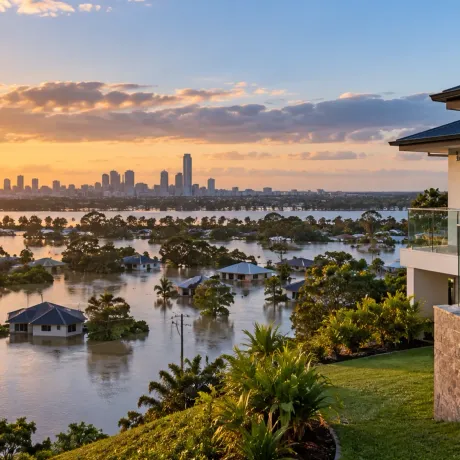
Flood-affected is a spectrum, not a label, which is why two properties with the same word attached can carry completely different risks. It can mean that the land has flooded, that water has come into the house itself, or simply that the lot sits within a mapped flood area.
The water can come from different sources, and each behaves differently. River and creek flooding, overland flow across the surface after heavy rain, and storm tide near the coast are all flooding, and a property can face one or several. Check what each map covers, because some council maps show river and creek flooding but not local stormwater or overland flow. There is also a difference between historical flooding, which is what has actually happened, and modelled flooding, which is what current studies predict could happen. Flood-prone pockets exist across South East Queensland, from Brisbane suburbs along the river to coastal creeks on the Gold Coast and Sunshine Coast, so the question is always how a specific block is affected, and how badly.
Degree matters most of all. A block that sits inside a mapped flood area but carries a house set well above the flood level is a different proposition from one where water has come through the living areas. Part of the job is to find the floor level relative to the flood level, meaning the height council expects floodwater to reach in the flood it plans for, because that gap often decides how much damage a flood actually does.
It helps to think in levels of severity:
| Severity | What it usually means | What to weigh |
|---|---|---|
| Land and access only | The lot or street floods, the house stays dry | Isolation and access, not building damage |
| Below-floor | Water reaches a subfloor, garage or under a raised house | Services, subfloor, moisture and foundations |
| Above-floor | Water enters the living areas | Major repairs, insurance cost and resale |
Working out which level applies is the single most useful fact you can establish early, because it changes everything that follows.
Personal insights from Elijah
Elijah Turkovic · Founder & Licensed Buyer’s Agent
In my experience, buying a flood-affected property can come with hidden costs, such as higher insurance premiums. The house itself may have been flood-affected without you knowing about it, because things can get patched up and fixed.
So you need to find out whether it has been flood-affected, how severely, and whether any recent repairs were done properly. You don’t want a dodgy patch-up job, where someone has just come in and fixed it up badly.
When you’re at the inspection, ask the real estate agent:
- Has this property been flood-affected?
- Has it been affected recently?
- Have any works or renovations been done to it?
All of these answers go into assessing a flood-affected property. The risk depends on how badly it has been affected. If a property is too highly flood-affected, my advice is to stay away.
How do you check if a house has flooded?
You check by combining council property-level information with state context, the seller’s knowledge and a physical inspection. No single source tells the whole story, so use several and compare them.
| Source | What it tells you | Limitation |
|---|---|---|
| Council property report | Flood information for the specific lot | Modelled levels, plus historical levels only where recorded |
| State and historical mapping | Regional and past-flood context | Broad context, not a verdict on one home |
| The agent and seller | What they know and disclose | Flooding history is not required on Form 2 |
| Building and pest inspection | Signs of past damage or poor repairs | A visual inspection cannot see everything |
Council property-level flood information
Start with the council, because it holds the most specific information for the lot. Brisbane publishes a FloodWise Property Report[1] for an address, including recorded 2011 and 2022 flood levels where available. The City of Gold Coast publishes flood maps[2], including a depth map for individual properties, and offers a paid flood level search[3] that gives the defined flood level for an address. Sunshine Coast Council provides online flood mapping and information[4]. Elsewhere, start with your local council’s website. These are the closest thing to a property-level answer.
State and historical flood mapping
Add the wider picture from the state’s flood mapping[5] and from FloodCheck Queensland[6], which shows historical and regional floodplain information. Treat it as context, not a verdict on one home: FloodCheck itself says it should not be used to judge flood risk at the property level, and points you to your local council.
Ask the agent, and check the record
Put Elijah’s three questions to the selling agent, ideally in writing: has the property been flood-affected, has that happened recently, and have any works or renovations been done because of it? Their answers guide your next checks. Do not rely on the Form 2 seller disclosure statement[7] for this, because it does not have to include a property’s flooding history. For a deeper walk-through, our Gold Coast flood maps guide covers reading maps and flood levels in detail.
Can flooding cut off access to the property?
Sometimes, and it is a risk buyers forget because they focus on the house. A home can sit high and dry while the only road in and out goes under water, which cuts you off during an event and matters for safety and everyday life.
Check how the property is reached and whether those roads, bridges or low crossings appear in the flood mapping. A single low causeway on the access route can isolate a property that is otherwise well above the flood level, which affects emergency access, getting to work or school, and how the next buyer sees the home. Ask how often access has been cut in past events, and weigh it alongside the building itself.
How do you tell if flood repairs were done properly?
You cannot tell for certain by eye, which is exactly why a flood-affected home needs a proper inspection rather than a quick look. The visible signs are prompts to investigate, not proof of anything on their own.
Water staining, fresh paint over the lower walls, brand-new flooring in an older house, or swelling and lifting in cabinetry can all point to past water, but they can also be ordinary renovation. Other clues include a straight horizontal line where wall linings have been replaced, new skirting boards, power points moved higher up the wall, a musty smell, and rust or tide marks in the garage or under the house. The risk is a dodgy patch-up, where damage has been covered rather than fixed. Commission a building and pest inspection and, where needed, a specialist moisture or structural investigation, so a professional looks behind the finishes. If water has been inside, have a licensed electrician check the wiring. Ask for repair records, and check whether the work needed building approval and received it (your solicitor or the council can search approval records), and use a licensed contractor[8] for any further work. Flood exposure on its own does not prove hidden defects, but it does raise the standard of checking the property deserves.
Two things are worth asking for specifically: the scope of any flood repairs, and who carried them out. Work done quickly, without approval, or by someone cutting corners is where hidden moisture and mould problems start, and those are expensive and slow to put right once the home is yours.
Can you insure a flood-affected property, and what will it cost?
Usually yes, but the cost and the cover vary widely, and that variation is a core part of the decision. As the Queensland Government’s flood insurance[9] guidance explains, home policies have used a standard definition of flood since June 2012: the covering of normally dry land by water that has escaped or been released from the normal confines of a lake, river, creek or other natural watercourse, a reservoir, canal or dam.
How a policy treats flood differs by insurer. Flood cover can be compulsory, included but removable, an optional add-on, capped at a low amount, or excluded entirely, and storm or rainwater damage is sometimes treated separately again. Premiums rise with flood risk. Most insurers assess it using the National Flood Information Database[10], alongside council flood maps, historical flood records and their own claims data. Read the Product Disclosure Statement (PDS) and the exclusions, and compare cover using independent guidance such as ASIC’s storm, flood and fire insurance[11] page.
The practical rule is to get written insurance quotes for the specific property before you go unconditional, not after. Insurance outcomes vary by insurer and property, and neither an expensive premium nor a dry past guarantees the next outcome, so quotes in writing are the only reliable guide to what cover will actually cost you. Arrange cover early, too: some insurers place a temporary embargo[12] on new policies when extreme weather is imminent, which can catch out a buyer who leaves it until the week of settlement in storm season.
How does flooding affect resale and future development?
Flooding follows the property, so it affects not just your purchase but your eventual sale. A flood history can narrow the pool of future buyers and the lenders and insurers willing to back them, which is part of why the price is lower in the first place.
It also shapes what you can do with the land. Council flood planning rules can set minimum habitable floor levels[1] for a new home, rebuild or major renovation, usually the flood level plus a safety margin of 300 to 500 millimetres, and filling the block[13] is controlled because it can push floodwater onto surrounding properties. Mitigation such as raising a home or using flood-resilient materials costs money even where it is possible. None of this makes a flood-affected property unsellable, but it does mean you should buy it understanding how the next buyer will see it. Done well, raising the home or flood-proofing key areas can also improve how a future buyer and their insurer see the property, which helps protect resale.
How should flooding change your offer price?
Flooding should change your offer only by the amount that compensates for the lasting cost, which is often different from the discount on the table. Price the risk, do not just accept the saving.
Add up the higher insurance premiums over the years you will hold it, any mitigation or repair work, and the discount you will likely give the next buyer, then weigh that against the saving today. Here is how that adds up, using illustrative figures only:
| Lasting cost | How it adds up | Example |
|---|---|---|
| Extra insurance | $2,500 a year for 7 years | $17,500 |
| Mitigation works | Such as a raised switchboard and flood-resilient flooring | $10,000 |
| Lower resale price | 5% of an $800,000 sale | $40,000 |
| Total | $67,500 |
On those numbers, a $40,000 discount today is not a bargain, while a discount nearer $70,000 might be. Your figures will differ, so use your written insurance quote and your inspector’s and builder’s estimates.
If the numbers work and the flood exposure is low, a flood-affected property can be a sound purchase, and this is exactly where sharp negotiation support earns its place, because the price has to reflect the real risk, not the agent’s framing of a bargain.
Be wary of a discount that only reflects stigma. If the price is lower simply because the word “flood” unsettles other buyers, yet the house sits well above the flood level and is cheaply insurable, that can be a genuine opportunity. If the discount barely covers years of higher premiums and a harder resale, it is not really a discount at all.
A flood checklist before you buy
Work through this before your contract goes unconditional:
- Have your solicitor review the contract and your conditions before you sign.
- Obtain the council property-level flood information for the specific lot.
- Cross-check the state flood mapping and FloodCheck for historical context.
- Check whether the access roads flood, not just the property.
- Ask the agent, in writing, about flood history and any flood-related works.
- Commission a building and pest inspection, plus a specialist investigation if needed.
- Ask for repair records and confirm any works were approved.
- Get written insurance quotes, and read the PDS and exclusions.
- Confirm with your lender or broker that finance still works once insurance is quoted.
- Price the insurance, mitigation and resale impact into your offer.
What if you are already under contract on a flood-affected home?
If you discover a flood history after signing, slow down and use your contract rather than panicking. The order matters.
- Speak to your solicitor first about your conditions and your rights, including any building and pest or finance conditions and your cooling-off position. In Queensland the cooling-off period[14] is usually 5 business days from when you receive the contract signed by both parties, does not apply to auction sales, and ending it can cost up to 0.25% of the price.
- Get the council flood information and a building and pest inspection quickly, because your conditional window is short.
- Obtain written insurance quotes so you know the real holding cost.
- Use the findings to renegotiate the price, or to end the contract where your conditions allow.
Common mistakes buying a flood-affected property
- Treating the discount as the reward without pricing the real cost.
- Relying on FloodCheck or a general map instead of council property-level information.
- Assuming fresh paint and new flooring are just renovation, not possible repairs.
- Skipping written insurance quotes until after the contract is unconditional.
- Assuming a dry past means a dry future, when the next flood may be bigger.
- Forgetting that the flood history will follow the property to the next buyer.
- Not involving a solicitor and inspector until it is too late to act.
How Amassed handles flood-affected properties
Amassed is an independent Queensland buyer’s agency working across Brisbane, the Gold Coast and the Sunshine Coast. Because we receive no commission, referral fee or kickback from sellers or selling agents, our only interest is whether a flood-affected property is right for you at the price.
On these purchases we pull the council flood information, arrange the right inspections, help you get insurance quotes before you commit, and work with your solicitor on the contract. You can see the kind of results this produces on our client results page, and it is part of our wider buyer’s agency service.
If you are weighing up a flood-affected property, talk to our team before you sign.
Frequently asked questions
Can you get a mortgage on a flood-affected property?
Often yes, but it is not guaranteed. Lenders generally require building insurance before settlement, as ANZ’s loan approval checklist[15] shows, so if cover is expensive or hard to get, finance can be affected. Because the loan and the insurance are linked, confirm both early with your broker or lender rather than assuming finance will fall into place. This is general information, not financial advice.
Is flood damage covered by home insurance in Queensland?
It depends on the policy. Flood has had a standard definition in Australian home insurance since June 2012, but cover can be included, optional, capped or excluded, and storm or rainwater damage may be treated separately. Always read the Product Disclosure Statement and the exclusions, and get a written quote for the specific property before you rely on being covered.
Does the Form 2 disclosure statement show if a property has flooded?
No. The Queensland seller disclosure statement does not have to include a property’s flooding history, so you cannot rely on it to tell you. Check the council’s property-level flood information, ask the agent in writing, and have the property inspected, rather than assuming that no mention on Form 2 means no flooding.
What is the difference between FloodCheck and a council flood report?
FloodCheck Queensland shows regional and historical floodplain information across the state, which is useful context but not a verdict on a single home. A council flood report gives property-level information for the specific lot, based on modelled flood levels, plus recorded historical levels where available. For a buying decision, rely on the council report and use FloodCheck for background.
Can you fix or reduce a property’s flood risk?
You can reduce the damage, but not the hazard itself. Measures such as raising the home, using flood-resilient materials, and improving drainage can limit the impact of a flood. These works cost money and need the right approvals, so factor them into your budget rather than assuming the risk can be removed.
Should I avoid every flood-affected property?
No. Severity and price decide. A property that catches minor overland flow, at a fair discount and with sensible insurance, can be a good buy. One that floods deeply from a river, is hard to insure, and was poorly repaired is the kind to avoid. The point is to judge each property on the facts, not the label.
How much cheaper should a flood-affected property be?
There is no fixed discount, because the right reduction depends on the specific property. A fair price reflects the higher insurance over the years you hold it, any mitigation or repair cost, and the discount the next buyer will expect. If the saving on offer does not cover those, the property is not actually cheap, however large the discount looks. Bring evidence to the negotiation: the insurance quote, the flood level and the floor height.
Can you still get flood cover if a property has flooded before?
Often yes, but usually at a higher premium, and some insurers may limit or decline cover on high-risk homes. A past flood does not automatically make a property uninsurable, but it does make written quotes essential before you commit, because the cost and the terms vary a lot between insurers for the same property.
What records should I ask the seller for?
Ask for repair records and invoices, building approvals for any flood-related work, and any history of insurance claims or known flooding. These help you see what happened and whether it was fixed properly. If the seller cannot provide them, treat that as a reason to investigate harder, not as proof that nothing went wrong.
Sources and references
- ↑[1] Brisbane City Council: FloodWise Property Report — property-level flood information for a Brisbane address.
- ↑[2] City of Gold Coast: Flood maps — the Gold Coast council’s flood mapping.
- ↑[3] City of Gold Coast: Flood level search — the defined flood level for a Gold Coast address.
- ↑[4] Sunshine Coast Council: Flood mapping and information — Sunshine Coast flood mapping, studies and information.
- ↑[5] Queensland Government: Flood mapping — where to find flood maps, and why to ask your council for property-level data.
- ↑[6] FloodCheck Queensland — the state’s historical and regional floodplain mapping tool.
- ↑[7] Queensland Government: Seller disclosure scheme — what the Form 2 statement does and does not include, in force since 1 August 2025.
- ↑[8] QBCC: Find a licensed contractor — checking that repair and building work is done by a licensed builder.
- ↑[9] Queensland Government: Flood insurance — the standard flood definition and how flood cover works.
- ↑[10] Insurance Council of Australia: Flood insurance explained — how insurers assess flood risk, including the National Flood Information Database.
- ↑[11] ASIC Moneysmart: Storm, flood and fire insurance — independent guidance on flood cover and comparing policies.
- ↑[12] Insurance Council of Australia: Storms — why some insurers pause new policies when extreme weather is imminent.
- ↑[13] City of Gold Coast: Planning for flood — how the defined flood level and a safety margin set floor heights, and why filling is controlled.
- ↑[14] Queensland Government: Cooling-off period — how long the cooling-off period runs, when it does not apply, and the cost of ending a contract in it.
- ↑[15] ANZ: Moving towards full home loan approval — an example of a lender requiring building insurance before settlement.

Elijah Turkovic is the founder of Amassed, a licensed buyer’s agent in Queensland (licence QPBL 4617660) and a member of the REIQ. He has spent more than 10 years in property, development and real estate, and lives in Broadbeach Waters on the Gold Coast.
He leads the team’s searches, due diligence and negotiations on home and investment purchases across Brisbane, the Gold Coast and the Sunshine Coast. Amassed acts only for buyers and takes no commissions, referral fees or kickbacks from sellers, agents or the inspectors it recommends.